


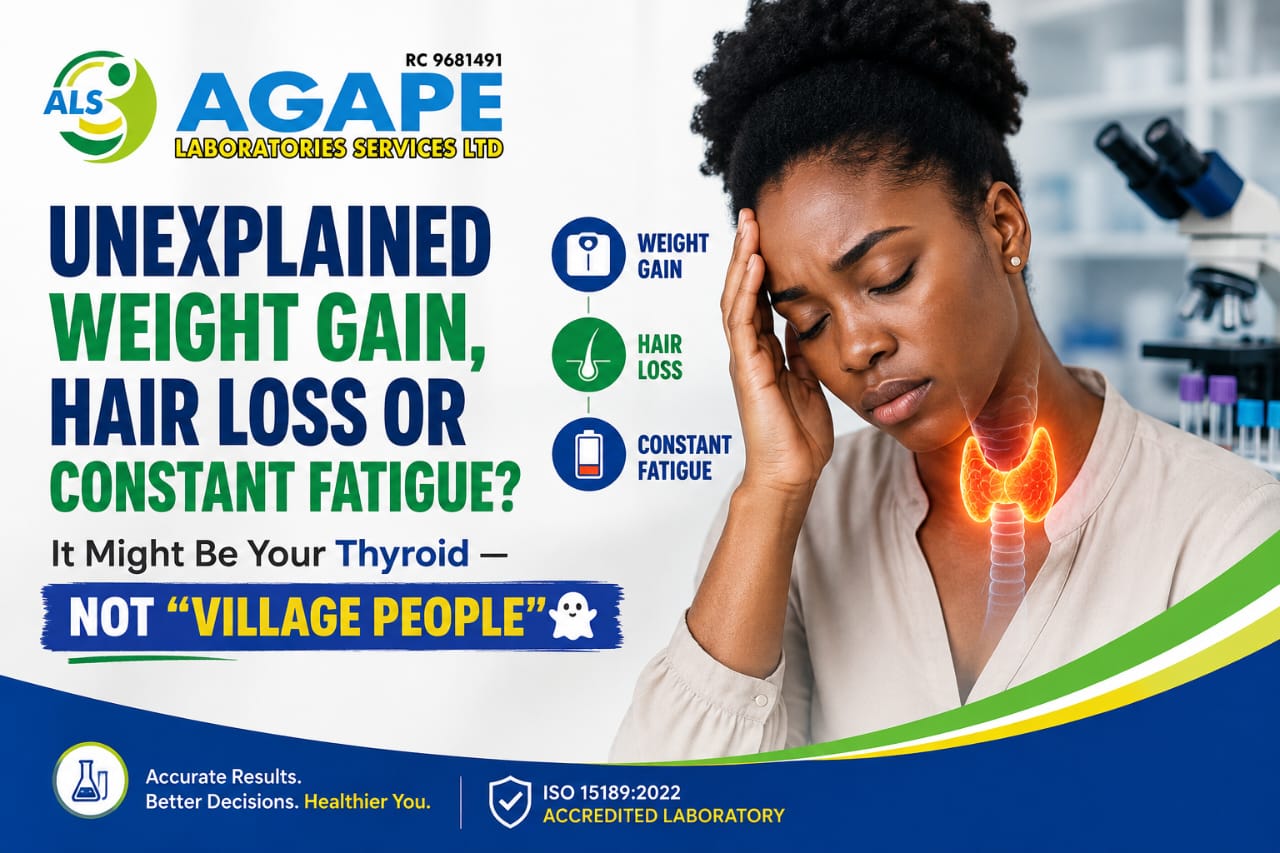
You are eating reasonably well, but the scale keeps climbing.
Your hair seems to be thinning more than usual.
And by 2 PM at your desk in Ikeja, Victoria Island or anywhere else in Lagos, you feel completely drained, even after what seemed like a good night’s sleep.
For many Nigerians, the first explanation might be stress, overwork, “body weakness”, or, jokingly, village people.
But sometimes, there may be a medical explanation worth investigating: your thyroid gland.
The Small Gland That Has a Big Job
Your thyroid is a small, butterfly-shaped gland located at the front of your neck. It produces hormones that help regulate how your body uses energy and influence important functions such as metabolism, heart rate and temperature regulation.
The main thyroid hormones are thyroxine (T4) and triiodothyronine (T3). Their production is regulated through a feedback system involving thyroid-stimulating hormone (TSH).
When this system becomes disrupted, symptoms can develop gradually and may easily be mistaken for stress or everyday exhaustion.
When the Thyroid Is Underactive
An underactive thyroid, known as hypothyroidism, can slow down several body processes.
Possible symptoms include:
- Persistent tiredness or low energy
- Unexplained weight gain
- Feeling unusually sensitive to cold
- Dry skin
- Hair thinning or hair loss
- Constipation
- Difficulty concentrating or “brain fog”
- Menstrual changes in some women
Having one or more of these symptoms does not automatically mean you have hypothyroidism. Stress, nutritional deficiencies, anaemia, sleep problems and other medical conditions can cause similar symptoms.
That is exactly why guessing is not enough.
What About an Overactive Thyroid?
An overactive thyroid, known as hyperthyroidism, can have the opposite effect.
Some people may experience:
- Unexplained weight loss
- A rapid or pounding heartbeat
- Increased sweating or heat intolerance
- Trembling hands
- Anxiety or nervousness
- Difficulty sleeping
- Increased bowel movements
Again, symptoms alone cannot confirm a thyroid disorder. Proper clinical evaluation and laboratory testing are important.
Why Thyroid Problems Can Be Easy to Miss
Thyroid disorders can affect both men and women, although some thyroid conditions are more common in women.
The challenge is that many symptoms are nonspecific.
Fatigue can be blamed on Lagos traffic and long workdays.
Weight gain can be blamed entirely on diet.
Hair loss may be treated with oils and supplements.
Brain fog may be dismissed as stress.
Meanwhile, an underlying medical condition may remain undetected.
Your body is giving you information. The right test can help interpret it.
How Do You Check Your Thyroid?
Thyroid function is commonly assessed using blood tests, with TSH often serving as an important initial test. Depending on the clinical situation, a healthcare professional may also request Free T4 and, in selected cases, Free T3 or other thyroid-related investigations.
The right combination of tests should be guided by your symptoms, medical history and clinical assessment.
A laboratory result is also most useful when interpreted alongside your overall health—not in isolation.
Get Answers Instead of Guessing
Persistent fatigue, unexplained weight changes and hair loss should not automatically be blamed on stress, ageing or “village people”.
Sometimes the explanation may be thyroid-related. Other times, it may be something completely different.
The important thing is to investigate rather than assume.
At Agape Laboratories Services (ALS), we are committed to providing reliable laboratory testing to support informed healthcare decisions. Our laboratory operates with a strong focus on quality and professional standards, including our ISO 15189:2022 accreditation.
If persistent symptoms are affecting your quality of life, speak with a qualified healthcare professional about whether thyroid function testing may be appropriate for you.
Your Symptoms Have a Story. The Right Test Can Help Tell It.
Visit Agape Laboratories Services at 50 Ago Palace Way, Adesola Bustop Okota, Lagos, explore our available tests, or contact us on +234 803 312 5326 for more information about laboratory services and sample collection options.
Don’t guess. Test appropriately. Get informed.